Trust in the Leader of Collaborative Process Design and Facilitation

LGU Officers: Your role in SE-GRM
You are one of the most accessible and trusted public institutions in any renewable energy project area. Long before a concern reaches a formal grievance mechanism, it often reaches the barangay hall, the municipal office, or a conversation with a local official. Constituents come to you when they see something they do not understand, when they feel unheard, or when they simply want to know what is happening in their community.
Your role is therefore much broader than supporting permits or regulatory processes. The Local Government Code recognizes the important role of LGUs in consultation and community participation for projects that significantly affect their communities. Beyond these legal responsibilities, you serve as the community's closest public institution, helping ensure that information flows openly, concerns are heard early, and issues are addressed before they become larger conflicts.
An effective Stakeholder Engagement and Grievance Redress Mechanism (SE-GRM) depends on active participation of local governance. By encouraging inclusive engagement, monitoring emerging concerns, coordinating with developers and government agencies, and helping constituents access the appropriate grievance channels, LGUs strengthen both community trust and project sustainability.
This page provides practical guidance on what you can do before development begins, during construction, and throughout project operations to help communities and projects succeed together.
PRE-DEVELOPMENT:
Legal basis: Sections 26 and 27 of the Local Government Code (RA 7160) recognize the role of LGUs in consultation and community participation for projects that may significantly affect local communities and the environment. Meaningful consultation helps improve project decisions, strengthen public confidence, and reduce future disputes.
Once a renewable energy project is proposed or awarded in your area, begin informing your community
Do not wait until construction begins before constituents learn about the project. As information becomes available, help explain what is known, what decisions are still pending, and where community members can ask questions or raise concerns. Early, accurate communication reduces uncertainty and prevents misinformation.
Encourage inclusive stakeholder mapping
Before community consultations begin, ask the developer how stakeholders have been identified. Encourage them to include tenant farmers, farm workers, fisherfolk, Indigenous Peoples where applicable, women, youth, informal resource users, and other groups that may experience project impacts even if they do not hold formal land titles.
Help create safe opportunities for everyone to be heard
Community assemblies remain important, but they do not always capture every voice. Encourage consultation approaches that provide additional opportunities for quieter or less represented groups to participate comfortably and independently.
T-17 Inclusive Engagement Design P-09 Contractor Onboarding Protocol
Support informed local decision-making
Before issuing endorsements or recommendations related to the project, consider whether community consultations have been adequately conducted and documented, including attendance, concerns raised, and responses provided. Good documentation supports transparency and strengthens public confidence in local decisions.
T-19 Consent Quality Assessment P-06 Pre-Engagement Entry Protocol
CONSTRUCTION:
During construction, your role shifts from preparing the community to helping maintain communication. Constituents often approach LGU officials first when they observe unexpected activities, damaged property, access restrictions, contractor behavior, or other project-related concerns. Timely referral and coordination can prevent these concerns from escalating.
Verify that communities are informed before site activities begin
When construction activities begin, confirm that affected communities have received advance information about what will happen, when it will occur, and whom to contact with questions.
T-10 Activity-Communication Alignment Tracker P-03 Pre-Activity Notification Protocol P-06 Pre-Engagement Entry Protocol
Help ensure community concerns enter the GRM
When constituents raise concerns informally, ask whether these have already been reported through the project's grievance mechanism. If not, encourage or assist them in referring the concern through the appropriate channel and follow up when necessary.
T-20 Grievance Register P-02 Informal Feedback Documentation P-20 Information Disclosure Protocol
Discuss emerging concerns with the developer regularly
Regular conversations with the developer's Community Relations team can reveal patterns before they become disputes. Review recent concerns, recurring issues, response times, and unresolved cases. If few or no concerns are being reported during active construction, consider whether community members know how to access the GRM or feel comfortable using it.
T-06 Signal Tracker T-07 Silence & Passive Consent Checklist P-01 Early Signal Capture
Listen carefully during periods of community benefits
Employment opportunities and community assistance programs often improve relationships, but they may also discourage some people from voicing concerns. Continue encouraging open dialogue and reassure constituents that raising legitimate issues will not affect access to project benefits.
T-09 Benefit-Masking Monitor P-11 Benefit Transparency Protocol P-19 Benefit Risk Management
OPERATIONS:
Once construction ends, community expectations change. Daily interactions become less frequent, project staffing is reduced, and concerns often shift from construction impacts to long-term operations, maintenance, benefit sharing, and future planning. The LGU continues to play an important role in maintaining communication and accountability.
Support a smooth transition from construction to operations
Ask the developer how community engagement will continue after construction. Encourage clear communication regarding new community contacts, grievance procedures, and continuity of commitments made during earlier project phases.
P-17 Continuity & Turnover Protocol T-36 Phase Transition Review
Designate a local grievance focal person
As a good governance practice, consider assigning an existing barangay or municipal staff member to receive project-related concerns, explain available grievance channels, and coordinate referrals when needed. This helps make the GRM more accessible to the community.
T-21 GRM System Builder P-10 Feedback Closure Protocol P-12 Grievance Response Alignment
Begin planning early for project transition and closure
Renewable energy projects have long operating lives. As projects mature, encourage discussions on employment transitions, land restoration where applicable, future land use, local revenues, and continuity of community benefits well before project closure.
Promote transparency and good governance
Where actual or perceived conflicts of interest may arise, voluntary disclosure and transparent decision-making strengthen public trust. Maintaining impartiality helps reinforce confidence that community interests remain at the center of local governance.
FOR ALL STAGES:
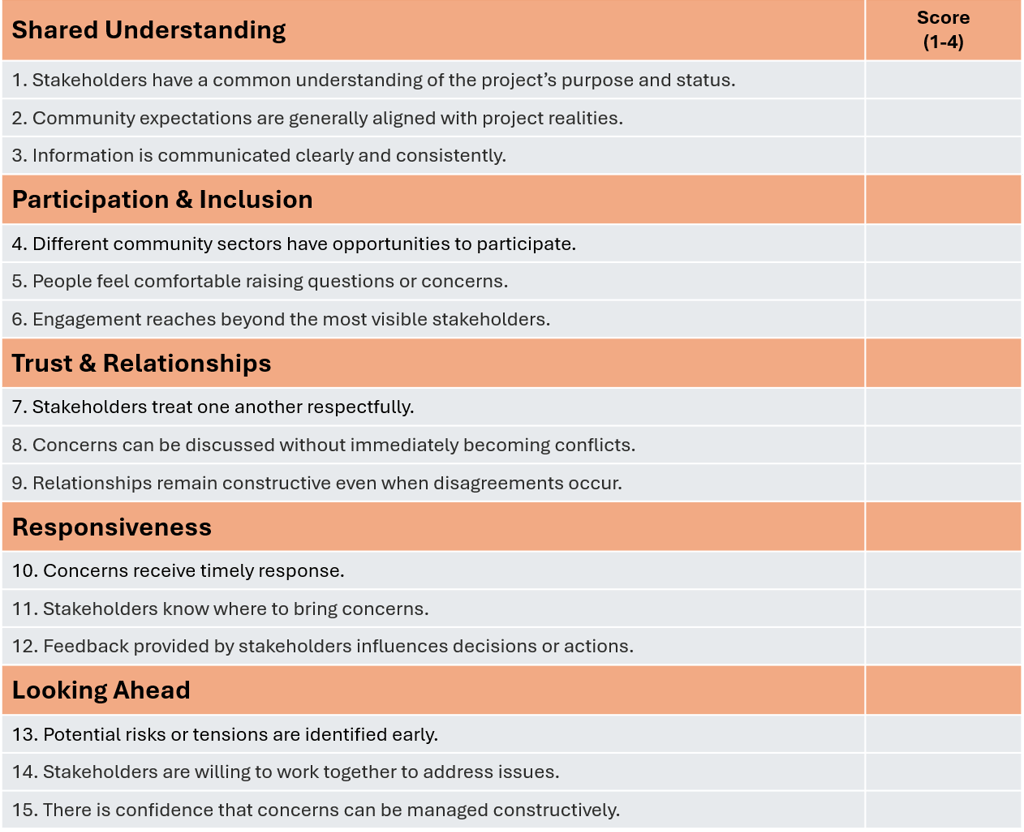
Joint Stakeholder Reflection Tool
Instructions: Each stakeholder group (Developer, LGU, Community Representatives) scores the statements independently from 1–4.
1 = Strongly Disagree 2 = Disagree 3 = Agree 4 = Strongly Agree
The purpose is not to obtain high scores. The purpose is to identify differences in perception.
Discussion Questions:
Where are our scores most different?
What explains these differences?
What concerns may not yet be visible in formal channels?
What one action can we take together in the next 30 days?
What support is needed from each stakeholder group?
This website shared to the public for free courtesy of the
THE CONFLICT RESOLUTION GROUP FOUNDATION, INC.
www.coregroup.org.ph * info@coregroup.org.ph
through our SustainABILITIES Lab Project
All rights reserved. The Conflict Resolution Group Foundation 2026.


© Pixelhaze 2024. A Hostinger Website Builder Template by Pixelhaze Studio