Trust in the Leader of Collaborative Process Design and Facilitation

TOOL T-07 | Assessment Checklist | Module 2: Signal Detection & Early Warning
Silence & Passive Consent Checklist
WHEN TO USE After any formal consultation or community meeting; whenever low participation depth or apparent agreement is recorded.
How to Use It
1. Complete this checklist within 24 hours of any formal consultation or community meeting.
2. Review meeting documentation: attendance, discussion log, and any concerns raised.
3. Answer each indicator question and record observations.
4. If three or more indicators suggest non-genuine participation, log a signal in the Signal Tracker and consider triggering the Safe Space Facilitation Protocol.
5. Document the checklist completion as part of the engagement record.
Purpose
To provide a structured prompt for distinguishing genuine agreement from guarded silence, conditional acceptance, or fear-based compliance. Silence and passive participation are among the most misread signals in community engagement, this checklist ensures practitioners pause to interpret them correctly.
Field Rationale
Attendance at consultations was frequently recorded as evidence of community acceptance. But observation revealed that community members were attending without expressing genuine concerns, either because they felt decisions were already made, or because they feared consequences for speaking.
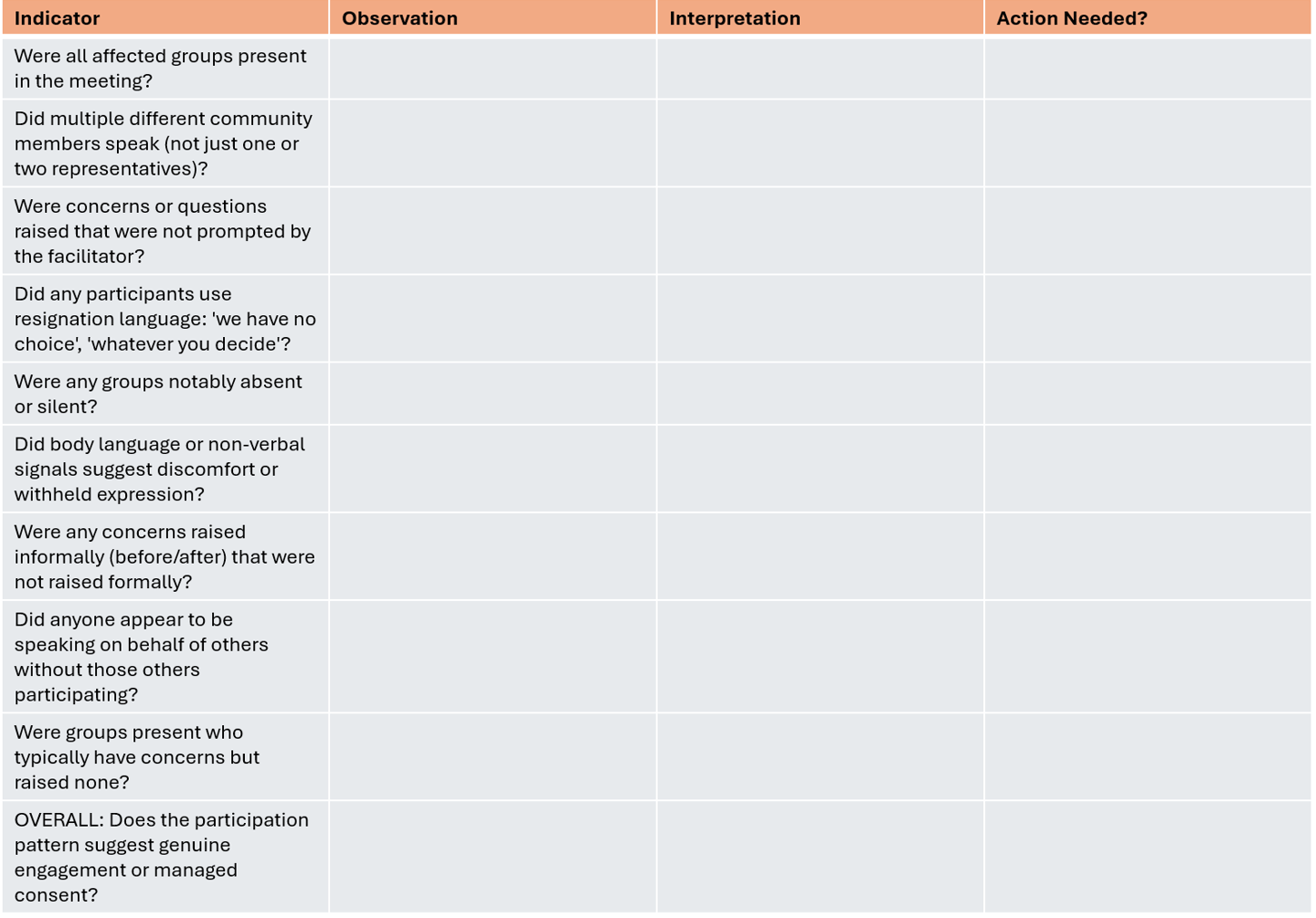
Fillable Template: Participation Quality Assessment
Guidance Notes
! Field Note — If you cannot confidently answer that the meeting produced genuine engagement, it should not be recorded as community acceptance. A meeting where people attended but did not speak is not a positive consultation outcome, it is a signal that a different kind of engagement is needed.
Adaptation Guidance
In high-stakes consultations (land acquisition, FPIC, major scope changes), a second observer should complete the checklist independently for comparison.
This website shared to the public for free courtesy of the
THE CONFLICT RESOLUTION GROUP FOUNDATION, INC.
www.coregroup.org.ph * info@coregroup.org.ph
through our SustainABILITIES Lab Project
All rights reserved. The Conflict Resolution Group Foundation 2026.


© Pixelhaze 2024. A Hostinger Website Builder Template by Pixelhaze Studio