Trust in the Leader of Collaborative Process Design and Facilitation

TOOL T-19 | Assessment | Module 5: Inclusion & Safe Expression
Consent Quality Assessment
WHEN TO USE After any consultation intended to establish community consent; before finalizing decisions that rely on community agreement.
How to Use It
1. After any consultation intended to establish consent, complete this assessment before recording the outcome as community agreement.
2. For each indicator, assess whether it is present in the engagement record or observed during the consultation.
3. If any red-flag indicators are present, do not record the outcome as consent, instead, document what was observed and plan further engagement.
4. Share the assessment with the engagement team and decision-makers before proceeding.
Purpose
To distinguish informed, voluntary consent from conditional, coerced, or procedural compliance, ensuring decisions requiring community agreement are based on genuine consent. Consent that is not genuine is not consent.
Field Rationale
Community members described using language at consultations that project teams recorded as acceptance: 'we support the project,' 'we have no objection.' But further inquiry revealed this language reflected resignation: 'we have no choice but to accept.' Recording these statements as consent created false confidence and a legitimacy deficit that surfaced when communities mobilized in opposition.
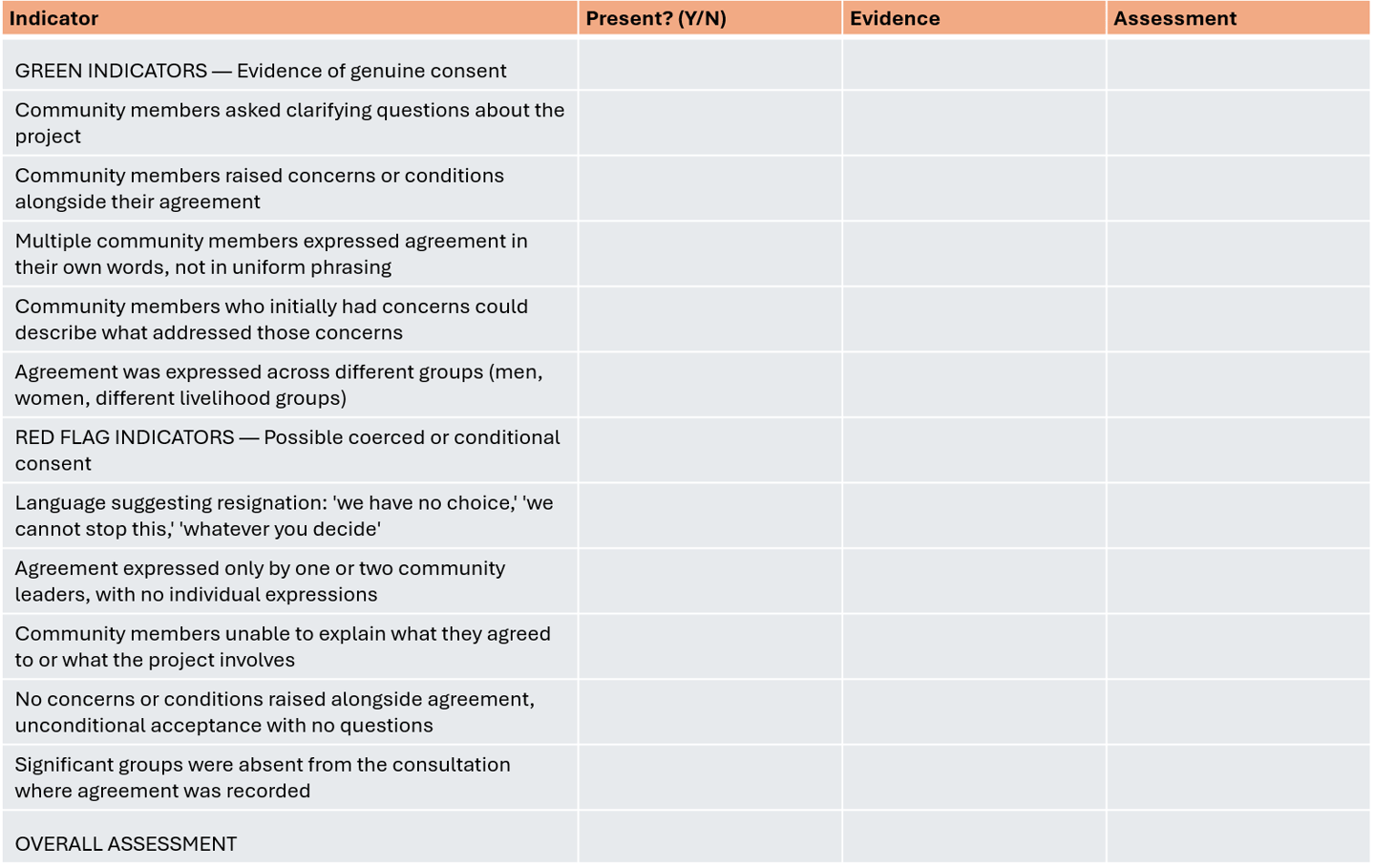
Fillable Template: Consent Quality Indicator Assessment
Guidance Notes
! Field Note — The most dangerous outcome is not a consultation where communities oppose the project, it is a consultation where conditional or forced agreement is recorded as genuine consent. False consent creates a legitimacy deficit that surfaces later, at a point where the cost of addressing it is much higher.
Adaptation Guidance
For FPIC processes, this assessment should be completed as part of official FPIC documentation. An FPIC process that fails the consent quality check has not produced FPIC, it has produced a compliance exercise with significant legal and reputational risk.
This website shared to the public for free courtesy of the
THE CONFLICT RESOLUTION GROUP FOUNDATION, INC.
www.coregroup.org.ph * info@coregroup.org.ph
through our SustainABILITIES Lab Project
All rights reserved. The Conflict Resolution Group Foundation 2026.


© Pixelhaze 2024. A Hostinger Website Builder Template by Pixelhaze Studio