Trust in the Leader of Collaborative Process Design and Facilitation

Your gap is Alignment across actors: permits, activities, and communication
A low score here in Section 2 does not mean your project is badly managed. It means the coordination complexity that is invisible to people inside the project is very visible to people outside it. Communities and LGUs experience misalignment not as a scheduling difficulty but as evidence that engagement is performative, that conversations are being held while decisions have already been made. These are the conditions that signal this gap is active in your project:
Site clearing, surveys, or equipment delivery are observed by communities before any notification has been given . . . and the project team does not yet know this has happened.
Contractors are mobilizing based on their own schedule without confirming that notification and permit status have been established for that specific area.
LGU officials are receiving questions from constituents about project activities they have not been briefed on. They are filling the gap with speculation, which is producing inconsistent answers across the community.
Community members receive different information depending on who they ask - the ComRel officer, the contractor supervisor, the barangay captain. No single shared reference exists.
Tenant farmers, farm workers, or fisherfolk who are directly affected by land or access changes are not listed in any project documentation. They do not have formal title, so they have not been found.
Clearing or construction has begun in areas where crops, aquaculture, or active livelihoods are still present, with no transition arrangements in place.
Communities describe feeling that decisions are already made. Engagement has shifted, from their perspective, from dialogue to observation.
Stakeholders cannot name which agency is responsible for a specific concern. No clear grievance pathway exists for the technology or jurisdiction involved.
Toolkit response — protocols, tools, and skills
The following protocols, tools, and skills address the conditions identified in Section 2 of the self-assessment. They are designed to be used together: the skills build the practitioner capabilities needed to recognize signals; the tools provide the structures for capturing and monitoring them; the protocols define when and how to act on what is found.
Tools
T-01 Stakeholder Mapping
T-02 Power & Influence Analysis
T-03 Conflict History Scan
T-04 Project Stage Risk Profiler
T-05 Community Context Assessment
T-10 Activity-Communication Alignment Tracker
T-11 Multi-Actor Messaging Matrix
T-12 Land & Permit Status Dashboard
T-13 Non-Landowner Impact Register
T-QR RE Permits Quick Reference
Where to go from here — your immediate actions
1 Activate T-10 Activity-Communication Alignment Tracker before your next site activity. For every planned field action, confirm: has the relevant community and LGU been notified? Is permit and acquisition status confirmed for this specific area? If either answer is no, the activity does not proceed. This is the single highest-leverage change available to a project with a low Section 2 score.
2 Establish T-12 as the single shared reference for all authorized activity areas. Every person who communicates with communities must work from the same document. If that document does not yet exist, creating it is more urgent than any engagement activity scheduled this week.
3 Use T-13 to specifically map non-landowners before activity advances further. Assign a named person, set a date, complete it before the next mobilization. Tenant farmers, farm workers, and fisherfolk are the most consistently missed stakeholders in land-based RE projects, and they are the ones most likely to experience the project without ever having been part of a conversation about it.
4 If jurisdictional confusion exists, trigger P-10 before the next community interaction. Do not let communities continue to be referred from one agency to another. Convene the relevant actors, establish who is responsible for which concerns, and make that information available to communities in plain language.
What the Evidence Shows
Four alignment failures appear consistently across project contexts in the field research. They are presented here in anonymized form.



The Invisible Stakeholder
Work Preceding Communication
Large-scale land-based RE project, pre-development to construction transition, agricultural community
Land acquisition proceeded in phases as parcels were secured progressively. Site preparation began in areas where acquisition was confirmed while other areas were still under negotiation. The project's stakeholder documentation was built around formal land title, which meant it captured landowners, LGU officials, and formal community representatives.
It did not capture tenant farmers and farm workers.
These were people whose livelihoods depended directly on the land. They planted and harvested on it. They had worked the same fields for years. But they held no formal title, so they did not appear in any acquisition list, notification schedule, or engagement record. No transition arrangements were offered to them. In several cases, they learned that clearing was beginning when they observed equipment arriving on the fields where their crops were still standing.
The Invisible Stakeholder is what happens when project documentation is built around formal title and formal roles, and the people most directly affected are simply not in the system. Tenant farmers, farm workers, fisherfolk, and informal users do not appear on land titles. They do not appear in LGU consultation lists. And if no one goes looking for them specifically, they do not appear at all, until the moment activity reaches them, and the damage is already done.
“If you already see work being done, that means the project is pushing through."
Community member
Multi-actor RE project, construction phase, multiple barangays
Contractors were mobilized and began site activities based on schedules that were not fully synchronized with the status of land acquisition and community notification. LGU officials received questions from community members about activities they were observing but had not been briefed on. Across the different actors involved, no shared real-time view of authorized activity areas and permit status existed. The result was a pattern of visible action that consistently ran ahead of explanation.
Work Preceding Communication is what happens when mobilization and notification run on separate tracks, and mobilization is faster. The community sees activity before they have any context for it. The LGU cannot explain what they are seeing. The ComRel officer is still preparing the briefing. By the time communication catches up, the community has already formed its interpretation of what the silence meant. And in a context where trust is already provisional, that interpretation is almost never charitable. Notification is not a courtesy. It is a precondition for everything else.
“The crops were still there. The harvest hadn’t finished yet, but clearing had already started.”
Community member
“Sometimes the work comes first. It wasn’t clear to us yet if everything was in order.”
LGU Official


Pre-development project, waterway context, emerging RE technology
Community members, fisherfolk organizations, and LGU officials had genuine and specific concerns about fishing access, about water conditions, about what the presence of new infrastructure would mean for livelihoods that depended on the waterway. They wanted to raise those concerns formally. They tried.
The technology involved was novel enough that the regulatory framework had not yet been finalized across the relevant agencies. When community members raised concerns with one institution, they were referred to another. When they followed the referral, they were directed elsewhere again. No project-specific grievance mechanism was operational. The concerns were real, the people raising them were persistent, and the system had no room for what they were bringing.
Concerns circulated in community conversations without ever entering a channel that could receive, track, or respond to them.
The absence of a formal mechanism was not experienced as bureaucratic delay. It was experienced as institutional abandonment.
Governance Gaps are what happens at the intersection of new technology, overlapping jurisdiction, and incomplete regulatory frameworks. In emerging RE technology contexts, multiple agencies hold partial authority, and the boundaries between them are not always clear even to the agencies themselves. When no single institution takes ownership of community concerns, the gap between institutions becomes, from the community's perspective, a gap in accountability. A concern with nowhere to go does not disappear. It accumulates, and it compounds every time someone tries to raise it and is turned away again.
Governance Gaps and
Institutional Confusion
WHAT NEEDS TO SHIFT
Each pattern below describes a condition that keeps the loop running. Read across and find what resonates in your context.
Notification needs to become a condition for mobilization, not an afterthought to it.
A single shared reference needs to exist, and everyone who faces the community must work from it.
Those without formal title need to be actively found and included, before decisions affecting them are made.
At least one actor needs to change posture (shifting from informing to listening), before the next interaction.
Every concern needs a named institutional home, and communities need to know where to bring it
DEVELOPER: You control the schedule and the information. Make notification a gate, not a courtesy. Build it into the system so it doesn’t depend on anyone remembering.
LGU / BARANGAY: You are the first face constituents turn to. Be honest when you don’t have the answer, and use that moment to demand better information from the developer rather than fill the gap with speculation.
COMMUNITY: You hold knowledge no one else has: what is actually happening on the ground. Name what you are seeing, to someone, even informally. Observation that stays private cannot interrupt anything.
CSO: You move across groups that don’t talk to each other. Carry what you hear in one room into another. Bridge the information gap before it becomes a trust gap.
NGA: You set the conditions under which others operate. Treat community-level misalignment as a compliance signal, and make that visible in your monitoring before it becomes a crisis.
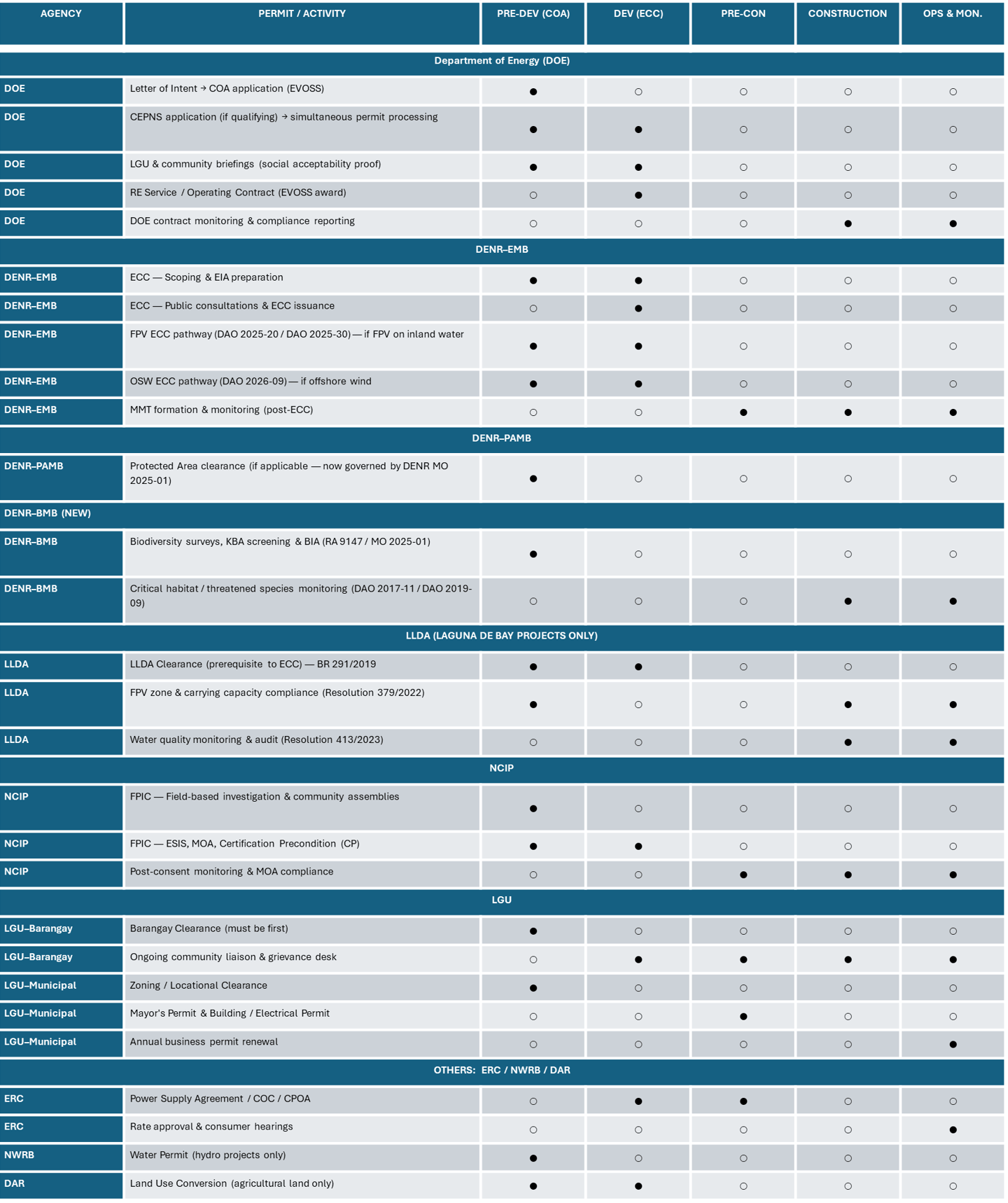
To aid in the alignment process, we have prepared an RE policy snapshot where SE-GRM comes into play:
DISCLAIMER
This document is produced by The Conflict Resolution Group Foundation, Inc. (The CoRe Group) for information and reference purposes only. It does not constitute legal advice and should not be relied upon as such. The information contained herein reflects publicly available regulatory issuances as of April 2026 and is subject to change without notice.
This reference guide does not create a lawyer-client relationship between The CoRe Group or any of their personnel and the reader. Regulatory requirements, permit conditions, and compliance obligations for renewable energy projects are complex, jurisdiction-specific, and may vary depending on the technology type, project location, applicable zoning, and other site-specific factors.
PROJECT ROADMAP · PERMIT & SE SEQUENCING
Read across each row to see when each permit and SE activity occurs.
● = Active in this stage ○ = Not in this stage
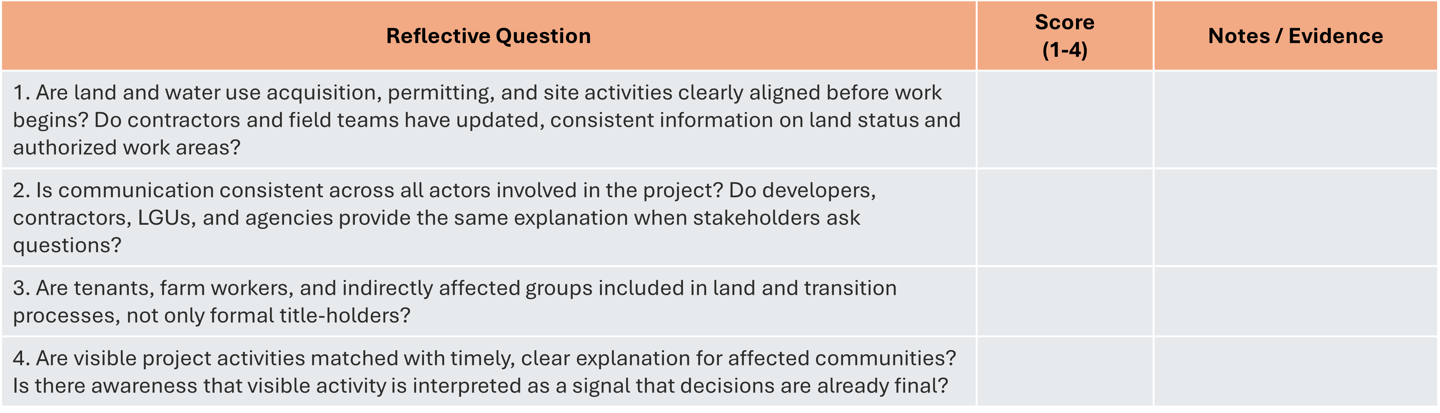
DIAGNOSTIC: SELF-ASSESSMENT SECTION 2
Work through these questions with your project team and, where possible, with LGU and community partners.
Score each on a 1–4 scale using the rubric in Annex A.
Pay particular attention to Q2.3 if your project involves agricultural land, as tenant and farm worker exclusion is the most consistently missed dimension in land-based RE projects.
This website shared to the public for free courtesy of the
THE CONFLICT RESOLUTION GROUP FOUNDATION, INC.
www.coregroup.org.ph * info@coregroup.org.ph
through our SustainABILITIES Lab Project
All rights reserved. The Conflict Resolution Group Foundation 2026.

© Pixelhaze 2024. A Hostinger Website Builder Template by Pixelhaze Studio