Trust in the Leader of Collaborative Process Design and Facilitation

SELF-ASSESSMENT TOOL 1
Comprehensive Reflective Questions
PURPOSE OF THIS TOOL:
This self-assessment helps developers, local government units (LGUs), community representatives, civil society organizations (CSOs), and national agencies reflect on how effectively stakeholder engagement (SE) and grievance redress mechanisms (GRM) are functioning within a renewable energy project.
It is not a compliance checklist. It is a diagnostic tool designed to identify where systems are working and where gaps may lead to future risks. The assessment is grounded in observed system patterns from field research
HOW TO USE:
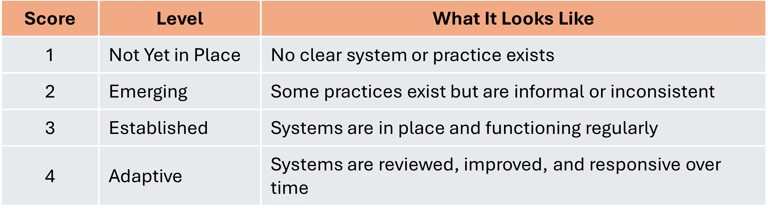
For each question, score the current condition of your system using the scale below. The assessment may be completed individually or in a multi-stakeholder session. If a question does not apply to your current project stage, mark it N/A.
REMEMBER
This is not a quiz, and there are no right or wrong answers.
This self-assessment is a reflection guide. It is a way to pause and examine the current state of your stakeholder engagement and grievance systems as they are actually experienced, not just as they are designed on paper.
Be honest rather than optimistic. The value of this tool lies in surfacing gaps early.
Score based on real practice, not intended processes or policies.
Differences in scoring across stakeholders are expected and valuable. They often reveal misalignment that would otherwise remain hidden.
A lower score is not a failure; it is a signal. It shows where attention, alignment, or support may be needed.
Focus less on the number, and more on the conversation behind the score. Why is this rated this way? What is happening on the ground?
Ultimately, this tool is meant to help you see the system more clearly, so that small adjustments can be made before issues escalate into conflict.
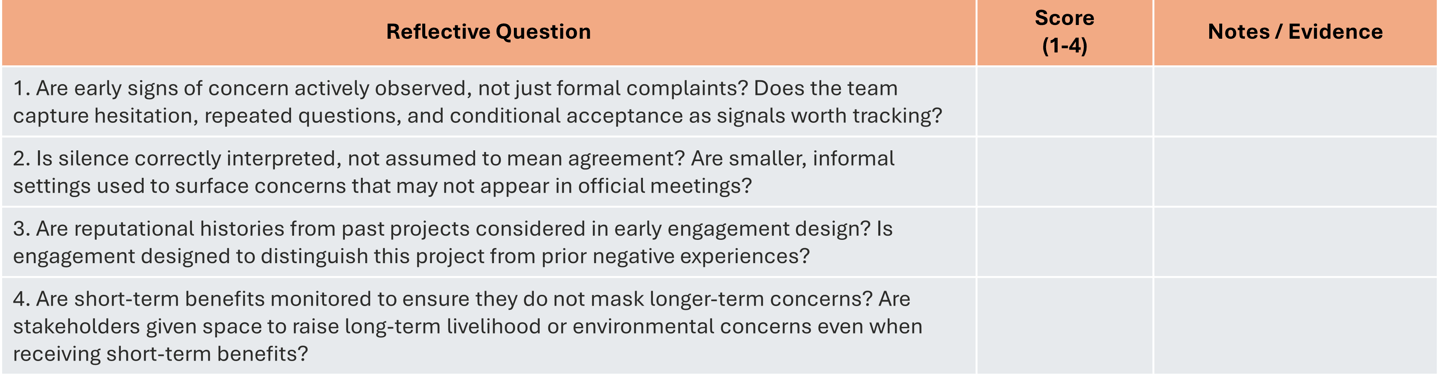
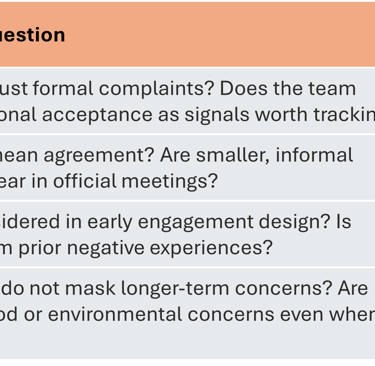
SECTION 1: Early Signals & Risk Awareness
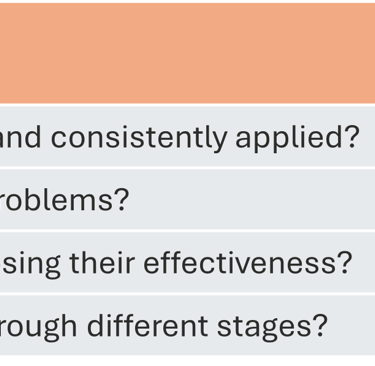
Examines whether early signals of concern are visible, recognized, and acted upon before they escalate. Field research shows that breakdowns rarely arise from a single failure - they accumulate when early, informal signals (hesitation, repeated questions, silence, side conversations) are missed or treated as non-issues.


Most critical during Pre-Development / Early Engagement
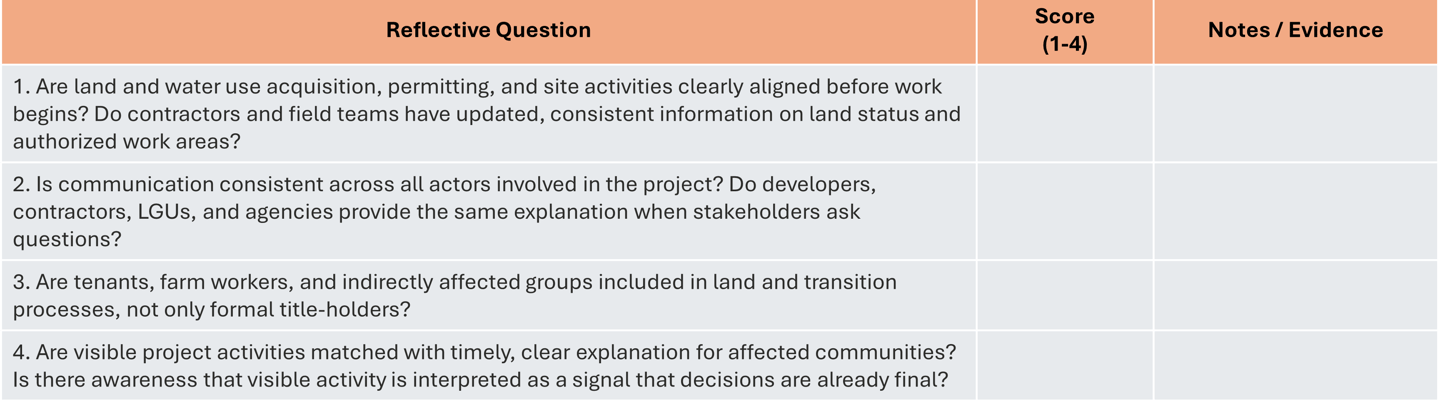
SECTION 2: Alignment of Land, Permits, Activities & Communication
Examines whether project actions, communications, and institutional roles are aligned and consistent across all actors. Misalignment across developers, contractors, LGUs, and regulators is experienced by communities as inconsistency and lack of transparency - even when processes are technically compliant.

Most critical during Development / Construction
SECTION 3: Inclusion, Shared Understanding & Safe Expression
Examines whether stakeholders are meaningfully included, whether project information is understood - not just shared - and whether there is a safe environment for raising concerns. Information disclosure alone does not reduce risk. Shared understanding across technical, institutional, and community perspectives is required.

Most critical during Pre-Development / Early Engagement

SECTION 4: Grievance and Feedback System
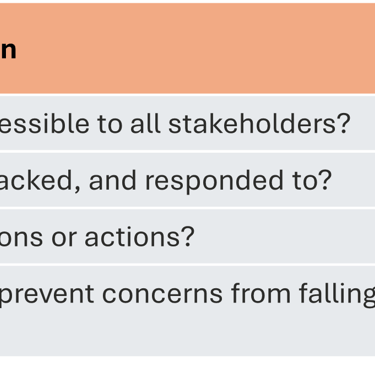
Examines whether concerns are captured, tracked, and responded to in a visible and timely manner. A GRM is not effective when it only processes formal complaints - it must also capture informal concerns, demonstrate how input is used, and close the loop with stakeholders.

Most critical during Pre-Development / Early Engagement

SECTION 5: Learning, Response & Institutionalization
Examines whether the system learns, adapts, and functions beyond reliance on individuals. Functional systems are not always resilient systems. When engagement depends on informal relationships and key personnel, continuity is at risk the moment those individuals change.

Most critical during Pre-Development / Early Engagement

INTERPRET YOUR RESULTS
The section/s with the lowest score will be your priority. Review the Tools, Protocols and Skills that will be most useful.
This website shared to the public for free courtesy of the
THE CONFLICT RESOLUTION GROUP FOUNDATION, INC.
www.coregroup.org.ph * info@coregroup.org.ph
through our SustainABILITIES Lab Project
All rights reserved. The Conflict Resolution Group Foundation 2026.
© Pixelhaze 2024. A Hostinger Website Builder Template by Pixelhaze Studio