Trust in the Leader of Collaborative Process Design and Facilitation

Your gap is in Early signal & risk detection
A low score on Section 1 means your system is waiting for problems to become formal before it sees them. By then, trust is already damaged and the cost of resolution is significantly higher. These are the early warning signs that this gap is active in your project:
Field teams report "no issues" based on the absence of formal complaints but community members are expressing concerns informally to contractors, at the market, or in barangay assemblies.
Low grievance register numbers are treated as evidence of community acceptance rather than as a possible sign that people don't believe filing will help.
Attendance at consultations is recorded as endorsement, even when community members are quiet throughout, or speak only after the formal session ends.
Concerns emerge suddenly at construction stage without any prior signal because earlier signals were present but not captured.
Short-term benefit delivery (jobs, CSR programs) appears to have resolved community concerns but the same issues resurface later with greater intensity.
A key ComRel officer leaves and the team loses all informal signal awareness because it lived in one person's relationships, not in a shared system.
Toolkit responsE: protocols, tools, and skills
The following protocols, tools, and skills address the conditions identified in Section 1 of the self-assessment. They are designed to be used together: the skills build the practitioner capabilities needed to recognize signals; the tools provide the structures for capturing and monitoring them; the protocols define when and how to act on what is found.
Your immediate actions for Section 1:
1. Set up T-06 Signal Tracker before your next engagement activity, even a simple shared spreadsheet is enough to start. The format matters less than the habit of logging. Train every team member who has community contact to contribute to it within the week.
2. Brief field staff and contractors using T-08 Frontline Staff Listening Guide before they enter community areas. Most early signals are first heard by people who are not the ComRel officer. They need to know what to notice and how to relay it.
3. Use T-07 Silence and Passive Consent Checklist within 24 hours of any formal consultation to review the quality of participation. If the checklist shows signs of non-genuine engagement, log a signal now and consider a follow-up in a smaller, safer format.
4. Activate P-02 Signal Escalation Protocol and define your thresholds before you need them. A signal tracker without an escalation protocol is a log that goes nowhere. The protocol is what turns observation into action.
If reputational history is a factor in your context, add P-07 Reputational Risk Briefing Protocol before the next community contact.
If you are entering construction or a new project phase
5. Deploy T-09 Benefit-Masking Monitor for any period when short-term employment or assistance is being delivered. Do not reduce signal monitoring because the community appears calm. This is exactly when underlying concerns get suppressed.
6. Schedule P-08 Early Warning Review Protocol as a standing bi-weekly item from the moment site activities begin. Waiting for problems to surface before reviewing signal data is too late.
What the Case Studies Show
The most consistent finding across all RE project contexts in this research is also the simplest: concerns were present before they became problems. In every context studied, early signals existed in the form of informal expressions of uncertainty, hesitation, questions that circulated outside formal settings, silence that reflected caution rather than acceptance. In most cases, those signals were not captured. They accumulated. By the time they surfaced as formal grievances or visible conflict, the window for low-cost resolution had closed.
Early signal detection is the first and most foundational system condition in this toolkit. It is foundational not because it is the most technically complex but because every other condition depends on it. You cannot address concerns you have not heard. You cannot respond to grievances that have never been formally raised. You cannot build trust through a system that communities have stopped believing will respond to what they share.
This Part addresses the practical question: how does a project team, and other actors including LGUs, CSOs, and community organizations, build the systems and practices to catch concerns early, before they become harder and more costly to resolve?.
Three patterns appear consistently across pre-development and early-engagement project contexts in the field research. They are presented here in anonymized form, the technology type and project stage are indicated, but no project is identified by name.


The Silence Loop
Reputational Spillover
Benefit Masking
Pre-development context: the silence loop
Community members attended consultations and engaged politely. Attendance sheets were signed, no formal objections were raised, and the engagement was recorded as proceeding without issues. But in smaller, informal conversations (in fishing communities after meetings ended, in interviews conducted separately), a different picture emerged. Concerns about livelihood impacts, access to fishing grounds, and the meaning of visible site activity were circulating actively in the community. They had simply never been raised in the formal setting. When asked why, community members described a consistent logic: they were uncertain whether their concerns were legitimate enough to raise formally; they had low confidence that raising them would produce any response; and the presence of officials and developer representatives created an atmosphere that felt more appropriate for listening than for questioning. The engagement record showed no concerns. The community’s experience showed otherwise.
The Silence Loop is what happens when the formal system creates conditions that make speaking up feel futile or risky — and then records the resulting quiet as acceptance. It is one of the most common and most costly misreadings in community engagement. The loop closes when silence is treated as data rather than as the absence of it.
“We thought the electricity would reach us. But it turns out there's no direct benefit for us."
Community member, pre-development context
This statement came not in a formal consultation but in a small-group conversation conducted separately. It captures a concern that had never entered any formal channel. No documented grievance had been filed. No signal had been logged. The concern existed. Everybody knows it, but the issue had not been formally documented and thus, was not discussed.
Pre-development context: reputational spillover
A new development initiative entered a community that had prior experience with an existing energy project. From the community’s perspective, that prior project had produced promises that were not kept, benefits that were unevenly distributed, and concerns that were raised but not addressed. When the new initiative began its early engagement, community members engaged cautiously. They withheld specific concerns and needs, waited to see how the new actors would behave, and were reluctant to invest in a relationship whose outcome they could not yet predict. The new project team interpreted this caution as a community personality characteristic rather than a response to a specific history they had not yet investigated. Months of early trust-building time were lost before the team understood what it had actually entered.
Reputational Spillover is what happens when a community's prior experience with development (broken promises, unaddressed concerns, uneven benefits) shapes how it responds to the next project, regardless of that project's intentions. Every team enters a community with a history. The question is whether they take the time to find out what it is.
Pre-development context: benefit masking
Short-term construction and site preparation jobs were provided to local residents during the early engagement phase. Visible resistance decreased during this period. Field monitoring recorded low signal activity.However, in interviews conducted, community members shared that they had suppressed existing concerns, particularly around environmental impacts, land use, and long-term livelihood effects, because expressing them felt risky while they were employed. When the jobs ended, these concerns resurfaced more openly. By that stage, however, key project decisions had already progressed. The sense that concerns had been temporarily quieted, rather than genuinely addressed, added a layer of distrust to the original issues.
Benefit Masking is what happens when short-term material benefits (employment, livelihood assistance, CSR programs) create conditions where communities feel unable to speak. The benefits are real. But they can function as a lid, not a resolution. A project that reads the quiet of a benefit period as community acceptance is measuring suppression, not satisfaction.
WHAT WE CAN DO TOGETHER:
Developer / ComRel Officer You design what gets captured and what doesn't. Build informal listening into the system (small group conversations, post-meeting check-ins, contractor signal relays) so that what doesn't get said in formal settings still has somewhere to go. A quiet consultation is not a clean record. It is an invitation to look closer.
LGU / Barangay You often hear things before the developer does. What constituents tell you informally, cautiously, or in passing is data. Treat what you hear in everyday conversation as worth passing on, and ask the developer how it is being captured. If you are not being asked, that is itself a signal.
Community / CSO Your hesitation, your silence, your conditional participation all mean something, and they are being read, accurately or not, by others in the room. Find a trusted channel and name what you are holding, even informally. A concern shared with a barangay official, an NGO, or a community organization is a concern that can still reach the system before it becomes a dispute.
NGA / Regulator Low grievance numbers during active project phases are not evidence of satisfaction. They may be evidence of a system that isn't reaching people. Ask what your monitoring is actually measuring. Ask also whether the absence of formal complaints reflects resolution or silence.
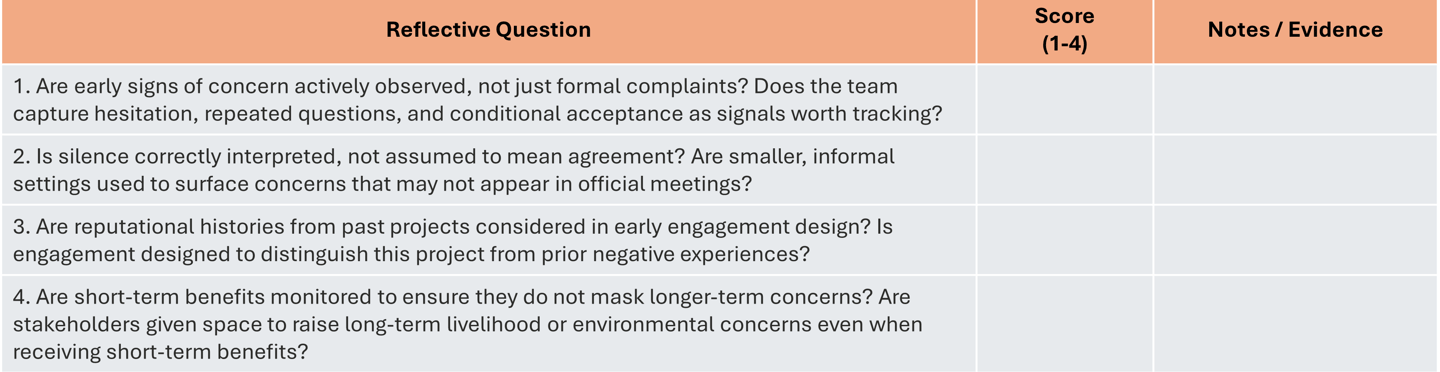
DIAGNOSTIC: SELF-ASSESSMENT SECTION 1
Take time to review and reflect on these questions at different stages of the project with your team, and where possible, with community representatives and LGU partners. Score each on a 1–4 scale using the rubric: 1 = Not yet in place, 2 = Emerging, 3 = Established, 4 = Adaptive.
If you score mostly 1s and 2s in this section, begin with the protocols and tools listed below before moving to other parts of the toolkit.
This website shared to the public for free courtesy of the
THE CONFLICT RESOLUTION GROUP FOUNDATION, INC.
www.coregroup.org.ph * info@coregroup.org.ph
through our SustainABILITIES Lab Project
All rights reserved. The Conflict Resolution Group Foundation 2026.


© Pixelhaze 2024. A Hostinger Website Builder Template by Pixelhaze Studio