Trust in the Leader of Collaborative Process Design and Facilitation

TOOL T-21 | Design Guide | Module 6: Grievance Redress System
System Builder
WHEN TO USE At project inception; reviewed and updated at each major phase transition.
How to Use It
1. Define GRM objectives for the project: what types of concerns must the system handle? What outcomes must it produce?
2. Design intake channels: identify all channels through which concerns can be raised and assign a designated receiver for each.
3. Define roles and responsibilities: who receives, logs, categorizes, assigns, responds, and closes each concern?
4. Define escalation pathways: what happens when a concern cannot be resolved at the frontline level?
5. Define response timelines: Routine, Urgent, and Sensitive categories with specific response commitments.
6. Design the feedback loop: how will stakeholders be informed of outcomes?
7. Communicate the GRM to communities: how will affected groups know the system exists and how to use it?
8. Document the system design and review at each phase transition.
Purpose
A step-by-step guide for designing a complete and context-appropriate GRM, including channels, roles, escalation pathways, response timelines, and feedback loops. The System Builder ensures that GRM design decisions are made deliberately and documented before the system is activated.
Field Rationale
In several sites, GRM systems existed in principle but had not been designed in a way that matched community context. Channels that were formally designated were not known to communities. Roles were assumed rather than assigned.
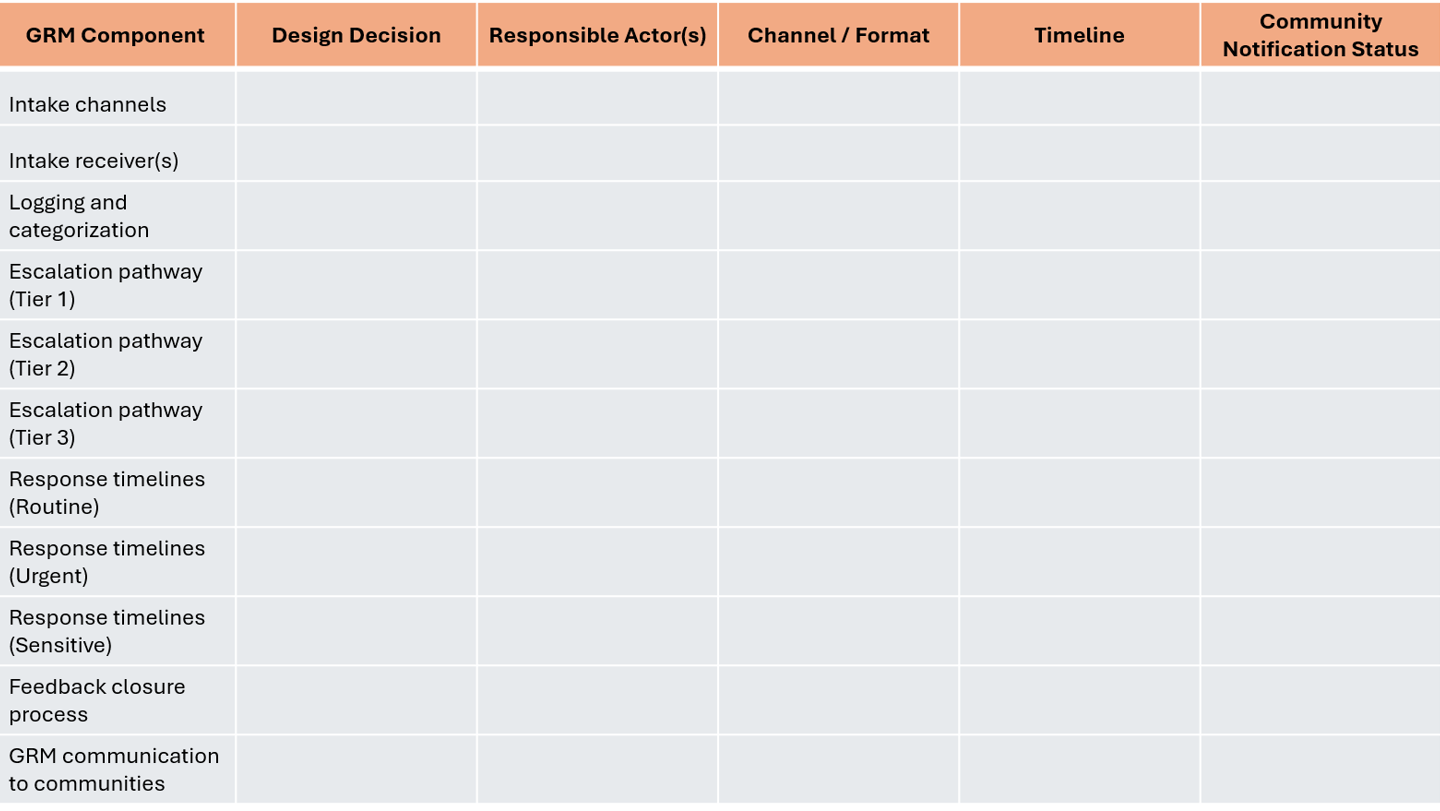
Fillable Template: GRM Design Documentation
Guidance Notes
! Field Note — The GRM design should be reviewed with the communities it is intended to serve, not just designed by the project team. Ask community representatives: Does this channel work for you? Will people know it exists? Can you use it without fear?
Adaptation Guidance
For projects involving novel technologies, the GRM design should explicitly address governance gaps, what happens when a concern falls outside the mandate of any existing institution.
This website shared to the public for free courtesy of the
THE CONFLICT RESOLUTION GROUP FOUNDATION, INC.
www.coregroup.org.ph * info@coregroup.org.ph
through our SustainABILITIES Lab Project
All rights reserved. The Conflict Resolution Group Foundation 2026.


© Pixelhaze 2024. A Hostinger Website Builder Template by Pixelhaze Studio