Trust in the Leader of Collaborative Process Design and Facilitation

TOOL T-20 | Register & Tracker | Module 6: Grievance Redress System
Grievance Register
WHEN TO USE Active from pre-development through operations; an entry is created every time a concern is received.
How to Use It
1. Create a register in a format accessible to all who receive concerns: a shared spreadsheet, paper logbook, or simple digital form.
2. Every time a concern is received, in any form or through any channel, create an entry within 24 hours.
3. For each entry, record: date received, who received it, channel, person raising the concern, description in their own words, category (Routine/Urgent/Sensitive), assigned response lead, expected response date.
4. Update the entry as the concern progresses: response actions taken, dates, and outcomes.
5. Close the entry only after the Feedback Closure Protocol has been completed, confirmed receipt by the person who raised the concern.
6. Review the register monthly for patterns: recurring concerns, slow response times, categories accumulating without resolution.
7. Retain the register for at least five years after project operations begin.
Purpose
The central log of all concerns raised (formal and informal) with tracking of status, responsible actor, response, and closure. The Grievance Register is the accountability backbone of the GRM: without it, concerns cannot be verified, patterns cannot be analyzed, and the system cannot demonstrate that it functions.
Field Rationale
The absence of a complete Grievance Register was the most consistent GRM gap. Concerns were received verbally but not logged. Informal relays through barangay officials were not recorded. By the time disputes escalated, there was no documented record of prior engagement.

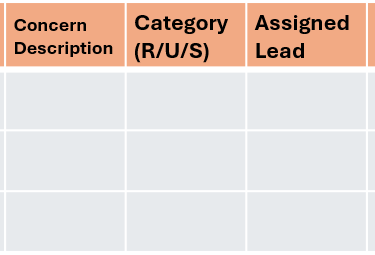
Fillable Template: Grievance Register
Guidance Notes
! Field Note — A Grievance Register that shows zero grievances from a project with active community engagement is almost always a sign of an incomplete register, not a project with no concerns. Train all staff to log concerns immediately, and audit the register monthly against what staff are actually hearing.
Adaptation Guidance
In communities with limited digital access, a paper register kept at the barangay hall or a designated community point is equally valid. What matters is accessibility, consistency, and completeness, not the format.
This website shared to the public for free courtesy of the
THE CONFLICT RESOLUTION GROUP FOUNDATION, INC.
www.coregroup.org.ph * info@coregroup.org.ph
through our SustainABILITIES Lab Project
All rights reserved. The Conflict Resolution Group Foundation 2026.


© Pixelhaze 2024. A Hostinger Website Builder Template by Pixelhaze Studio