Trust in the Leader of Collaborative Process Design and Facilitation
TOOL T-37 | Documentation Guide | Module 10: Learning, Monitoring & Institutionalization
SOP Builder
WHEN TO USE When informal SE-GRM practices need to be formalized; at project start to document designed processes; at phase transitions to capture emerging practices.
How to Use It
1. Identify the SE-GRM practice to be documented: a signal recognition approach, a community visit protocol, a grievance intake sequence.
2. Interview the practitioner who currently performs the practice: what do you do, in what sequence, using what tools, with what decision rules?
3. Draft the SOP using the template: purpose, trigger, steps, roles, required outputs, and common exceptions.
4. Test the draft with a second practitioner: can they follow it without further guidance? If not, revise.
5. Review with community contacts where applicable: does the documented practice match what they experience?
6. Store in a shared location accessible to all relevant staff.
7. Review and update annually or whenever the practice changes significantly.
Purpose
A guide for converting informal engagement and GRM practices into documented, role-specific standard operating procedures, so that the system survives staff turnover and operates consistently regardless of who is in the role.
Field Rationale
A highly effective informal SE-GRM operated primarily through the personal relationships and practices of a single ComRel officer. When that officer left, the system largely disappeared, because the practices were never documented and the relationships were never transferred.
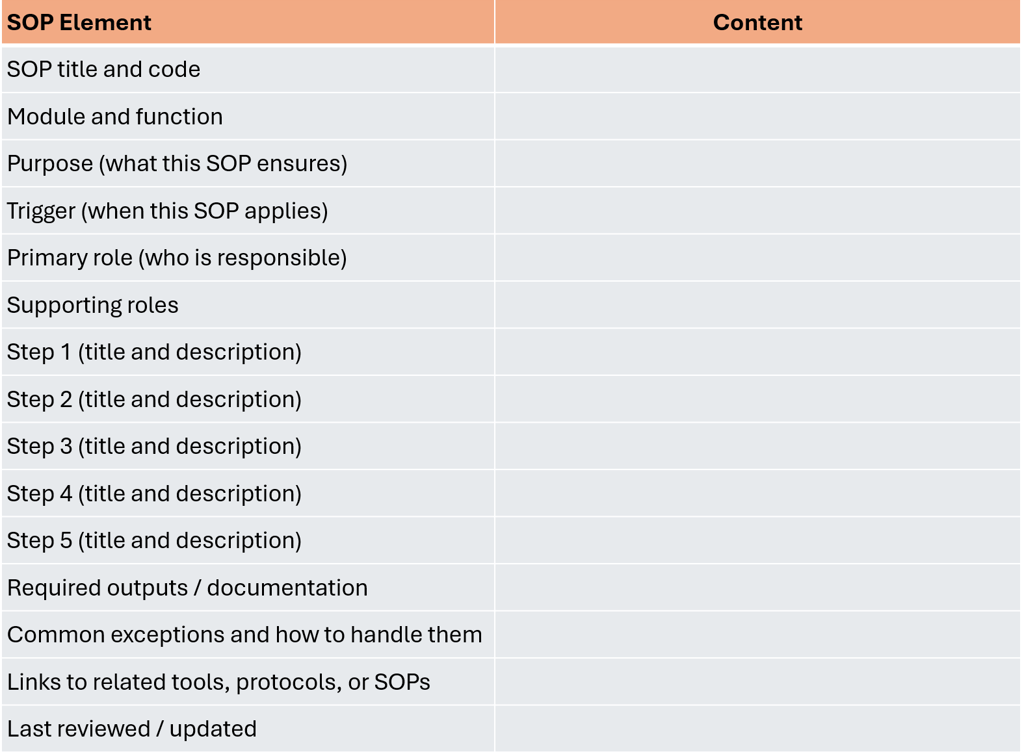
Fillable Template: Standard Operating Procedure Template
Guidance Notes
! Field Note — The test of a good SOP is not whether it is comprehensive, it is whether a new staff member can follow it on their first week without supervision and produce the same outcome as an experienced practitioner. Write for the person who does not yet know the context.
Adaptation Guidance
Do not wait until staff transitions to write SOPs. The best time to document a practice is when the practitioner is still present and can be interviewed. Departure documentation misses tacit knowledge.
This website shared to the public for free courtesy of the
THE CONFLICT RESOLUTION GROUP FOUNDATION, INC.
www.coregroup.org.ph * info@coregroup.org.ph
through our SustainABILITIES Lab Project
All rights reserved. The Conflict Resolution Group Foundation 2026.
© Pixelhaze 2024. A Hostinger Website Builder Template by Pixelhaze Studio