Trust in the Leader of Collaborative Process Design and Facilitation

TOOL T-25 | Monitoring Tool | Module 7: Conflict Assessment & Mapping
Escalation Tracker
WHEN TO USE When a signal or grievance shows signs of escalating beyond routine GRM response.
How to Use It
1. When a signal or grievance shows early signs of escalation, create an Escalation Tracker entry.
2. Log key events in sequence: what happened, when, who was involved, and what was done in response.
3. Assess the current stage: Signal (informal, pre-grievance), Grievance (formal concern submitted), Dispute (organized expression of opposition), or Breakdown (community organizing, media involvement, or legal action).
4. At each assessment, identify: the most likely next escalation step if nothing changes, and the intervention that could interrupt that path.
5. Update after every significant development.
6. Close when the underlying issue is resolved, not just when the surface expression subsides.
Purpose
To monitor the trajectory of a concern or conflict over time, distinguishing early signal, active grievance, dispute, and breakdown stages, and identifying decision points where intervention can prevent further escalation. Escalation follows a traceable path that, if monitored, creates intervention opportunities.
Field Rationale
Conflicts that reached crisis point had escalation histories that, in retrospect, were clearly visible. Early signals, then informal concerns, then formal grievances, then organized opposition, each stage had indicators that were present but not acted on.

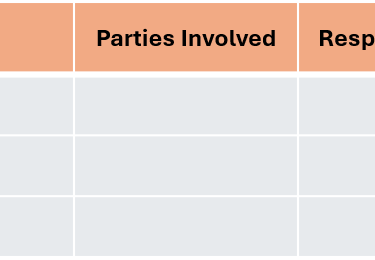
Fillable Template: Escalation Timeline
Guidance Notes
! Field Note — The most critical intervention point is between Signal and Grievance, before community members organize formally around a concern. By the time a concern reaches Dispute stage, the cost and difficulty of resolution have increased significantly. Use this tracker to identify early intervention opportunities.
Adaptation Guidance
The stage boundaries are not rigid, a situation can move between stages rapidly in response to external events (LGU actions, media coverage, political dynamics). Track trajectory, not just current stage.
This website shared to the public for free courtesy of the
THE CONFLICT RESOLUTION GROUP FOUNDATION, INC.
www.coregroup.org.ph * info@coregroup.org.ph
through our SustainABILITIES Lab Project
All rights reserved. The Conflict Resolution Group Foundation 2026.


© Pixelhaze 2024. A Hostinger Website Builder Template by Pixelhaze Studio