Trust in the Leader of Collaborative Process Design and Facilitation

TOOL T-30 | Documentation | Module 8: Facilitated Dialogue & Negotiation
Agreement Documentation Template
WHEN TO USE Whenever a dialogue or negotiation session produces any form of agreement, commitment, or understanding.
How to Use It
1. Before closing any dialogue or negotiation session, read back the key agreements aloud.
2. Confirm that all parties understand and agree to the record before it is finalized.
3. Complete the agreement template during or immediately after the session, not several days later.
4. All parties sign or initial the document.
5. Distribute a copy to all parties.
6. Establish a monitoring mechanism: who will verify that commitments are fulfilled, and by when?
7. If any commitment is not fulfilled by the agreed deadline, trigger a follow-up meeting within 5 working days.
Purpose
To create a clear, mutually agreed written record of outcomes from dialogue and negotiation, including commitments, timelines, responsible actors, and verification mechanisms. Undocumented agreements are forgotten, reinterpreted, or denied.
Field Rationale
Verbal agreements made in barangay meetings or informal negotiations were later disputed, not because of bad faith, but because the parties had different recollections of what was agreed.
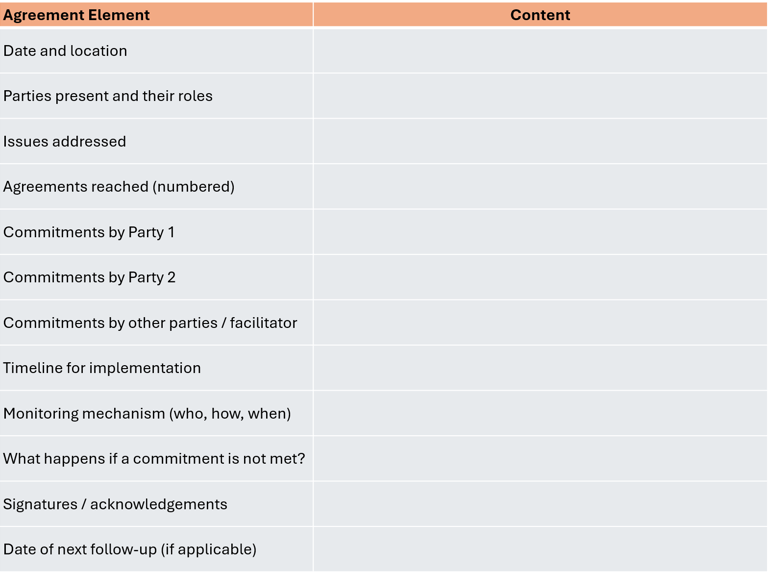
Fillable Template: Agreement Record
Guidance Notes
! Field Note — An agreement that is not documented is an oral understanding that two parties will remember differently in six months. Documentation is not a sign of distrust, it is a sign of respect for the process and the parties.
Adaptation Guidance
For communities with low literacy, use visual confirmation methods: a thumb-impression, an 'X' mark, or a witnessed verbal acknowledgement recorded in a note. The goal is mutual confirmation, not a formal legal document.
This website shared to the public for free courtesy of the
THE CONFLICT RESOLUTION GROUP FOUNDATION, INC.
www.coregroup.org.ph * info@coregroup.org.ph
through our SustainABILITIES Lab Project
All rights reserved. The Conflict Resolution Group Foundation 2026.


© Pixelhaze 2024. A Hostinger Website Builder Template by Pixelhaze Studio