Trust in the Leader of Collaborative Process Design and Facilitation

TOOL T-26 | Analysis Tool | Module 7: Conflict Assessment & Mapping
Root Cause Analysis Worksheet
WHEN TO USE When a grievance recurs, persists without resolution, or reflects a systemic condition.
How to Use It
1. Identify the concern to be analyzed: be specific about the presenting issue.
2. Ask 'Why?' five times (or until you reach a root cause that cannot be answered with another 'Why'): Why did this concern arise? Why did that occur? Continue until you reach a root cause.
3. Identify whether the root cause is: a communication failure, a process gap, a coordination failure, a structural inequality, an unresolved prior grievance, or an external factor.
4. For each identified root cause, identify: whether it is within the project's control, what structural change would address it, and who is responsible.
5. Document the analysis and share with project management.
6. Track whether recommended structural changes are implemented.
Purpose
To identify the underlying drivers of a concern or conflict beyond its surface manifestation, enabling structural responses rather than case-by-case management. A concern about a specific land boundary may have a root cause in inadequate notification processes. A recurring noise complaint may have a root cause in contractor schedule misalignment.
Field Rationale
The same types of concerns appeared repeatedly in different forms. Case-by-case responses closed individual instances but did not address the conditions producing them. Root cause analysis would have identified structural drivers and enabled responses that prevented recurrence.
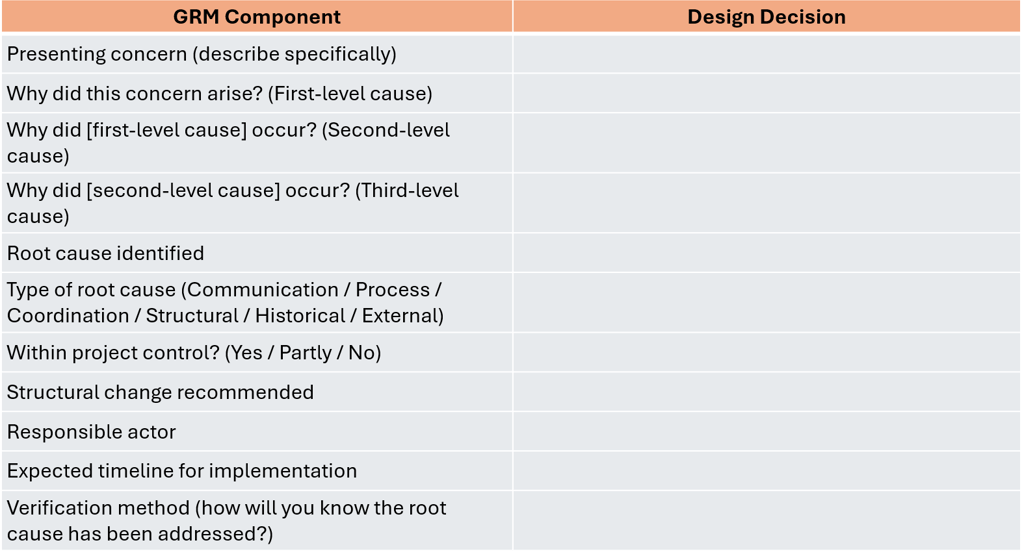
Fillable Template: Root Cause Analysis
Guidance Notes
! Field Note — Root cause analysis is not about assigning blame, it is about identifying what needs to change for the concern to stop recurring. Keep the analysis focused on conditions and processes, not individuals.
Adaptation Guidance
For concerns with a long history or complex multi-party dynamics, root cause analysis may require input from community members, not just project staff. Their perspective is often more accurate than an internal analysis.
This website shared to the public for free courtesy of the
THE CONFLICT RESOLUTION GROUP FOUNDATION, INC.
www.coregroup.org.ph * info@coregroup.org.ph
through our SustainABILITIES Lab Project
All rights reserved. The Conflict Resolution Group Foundation 2026.


© Pixelhaze 2024. A Hostinger Website Builder Template by Pixelhaze Studio