Trust in the Leader of Collaborative Process Design and Facilitation
TOOL T-05 | Diagnostic | Module 1: Pre-Engagement Diagnostics
Community Context Assessment
WHEN TO USE Before designing any engagement approach for a new community or project area.
How to Use It
1. Gather basic livelihood and social structure data: primary livelihoods, seasonal cycles, land use patterns, community organizations, and social hierarchies.
2. Identify language and literacy context: primary language, literacy rates, and any groups with limited language access.
3. Identify cultural and religious practices that affect engagement timing and format: significant dates, prayer times, community customs around decision-making.
4. Map the geography of the community in relation to the project area: who lives closest, whose livelihoods are most directly affected, who has to travel to reach venues.
5. Identify existing community organizations and informal networks: cooperatives, women's groups, youth groups, religious organizations.
6. Document vulnerability indicators: which groups have least access to formal channels, which are most economically dependent on project-affected resources.
7. Record the context assessment and make it accessible to all staff engaged in community work, not just the lead ComRel officer.
Purpose
To capture the livelihood profiles, social structures, land use patterns, cultural practices, and vulnerability indicators of a community before engagement begins, so that engagement formats, channels, timing, and content are designed with genuine knowledge of local context.
Field Rationale
The engagement approach relied heavily on one ComRel officer who had built deep local relationships. This worked, but only because that officer had invested time in understanding the community context. When staff transitioned out, the context knowledge was not documented and engagement quality dropped immediately.
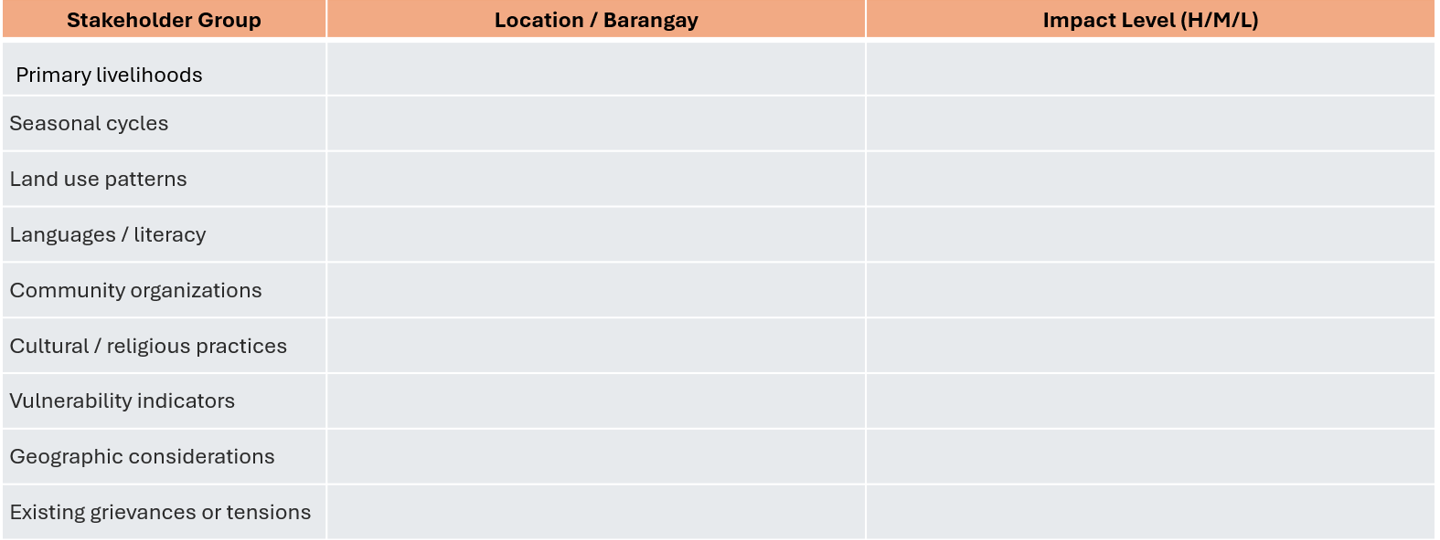
Fillable Template: Community Context Record
Guidance Notes
! Field Note — Community context knowledge held only in one staff member's mind is institutional knowledge at risk. At Nabas Aklan, the informal SE-GRM worked because one individual understood the community deeply, but when they transitioned out, that knowledge was not transferred. Document what you learn.
Adaptation Guidance
In communities with multiple barangays, each may have significantly different context profiles. Do not assume that knowledge of one barangay extends to others, map each separately.
This website shared to the public for free courtesy of the
THE CONFLICT RESOLUTION GROUP FOUNDATION, INC.
www.coregroup.org.ph * info@coregroup.org.ph
through our SustainABILITIES Lab Project
All rights reserved. The Conflict Resolution Group Foundation 2026.
© Pixelhaze 2024. A Hostinger Website Builder Template by Pixelhaze Studio